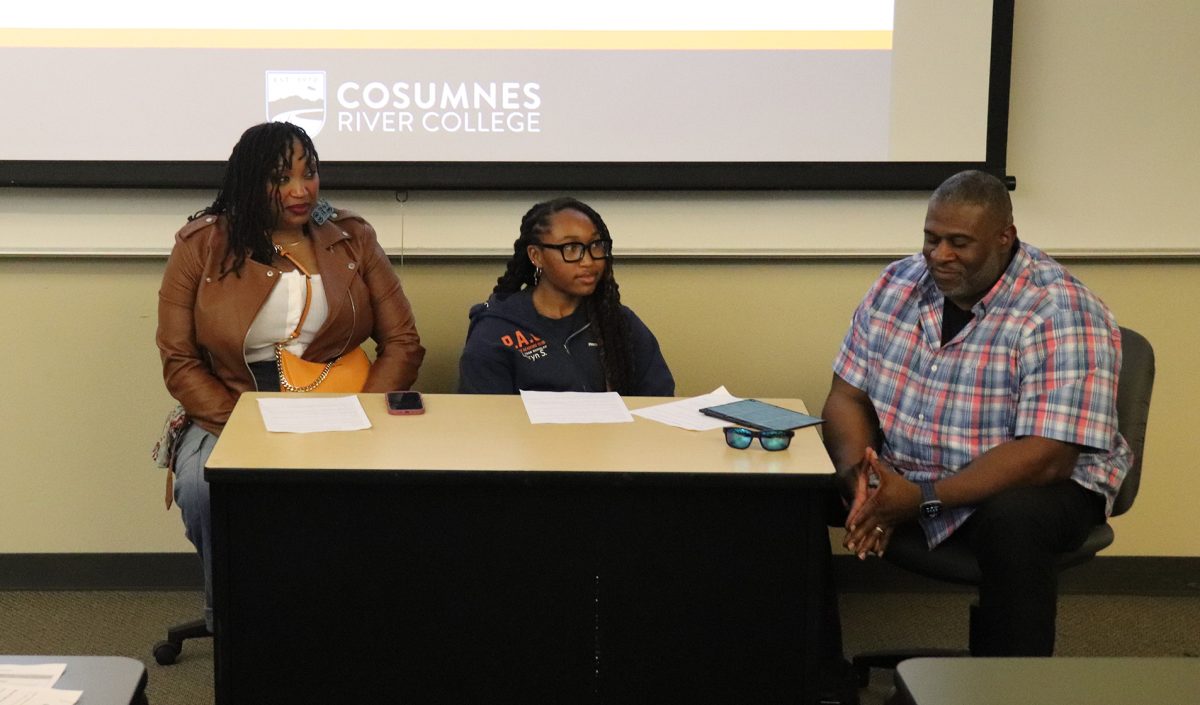
To celebrate Women’s History Month, Cosumnes River College hosted a “We Can Do Hard Things: A Story of Resilience” presentation and storytelling event in the Learning Resource Center on Friday.
The event was a collaboration between the Social Work/Human Services department and Emergency Medical Technology department.
Social work instructional assistant Brianna Furiosi said the purpose of the event was to help students navigate through difficult situations in their lives.
“The goal of it is to understand that we are all resilient,” Furiosi said. “Sometimes we may go through hard things in life, but we can overcome it.”
The event featured the experiences of a family who had to deal with their child being injured.
Jones-Thomas and Emergency Medical Services professor Samantha Juner brought in Shannon, Maurice, and Lauren Scott to share their story of a challenging incident that happened within their family, and how they overcame it. The Scott family described a time when one of their children cut his forehead and was bleeding after he fell off a trampoline and how they had to respond quickly and calmly to deal with the situation.
The family described this as an act of resilience because the family was able to stay calm and take the child to the emergency room despite what was a stressful time for their family.
The event was designed to help demonstrate how individuals can be calm and persevere even in challenging times. Social work professor and event organizer Brandy Jones-Thomas said this event came about because students were having trouble balancing school and other things going on in their personal lives.
“Students weren’t knowing what to do with that, and so I wanted to use this opportunity to say being resilient doesn’t change that things are hard; it just gives you more tools to deal with it,” Jones-Thomas said.
After the Scott family told their story, the audience asked them questions about how they coped with and recovered from the situation.
Jones-Thomas said it is important for students to hear stories of resilience like the Scott family because it makes them better equipped to deal with difficult situations in their own lives.
“The more people that learn to talk through some of the things, and see where they have strengths and build their confidence are more apt to do the hard things,” Jones-Thomas said.
The case study was followed by a panel discussion with current and former social work and EMS students. The discussion included topics such as making sure to use empathy with all patients and giving each patient the same care regardless of gender, sexual orientation, race or political affiliation.
Tatiana Aksenova, a 32-year-old human services major, said the event was a good opportunity to gain more insight in her field.
“It’s my first time in this kind of event, and it’s a good experience for me because I’m going to be in this field, and it’s good to know how it works,” Aksenova said.