
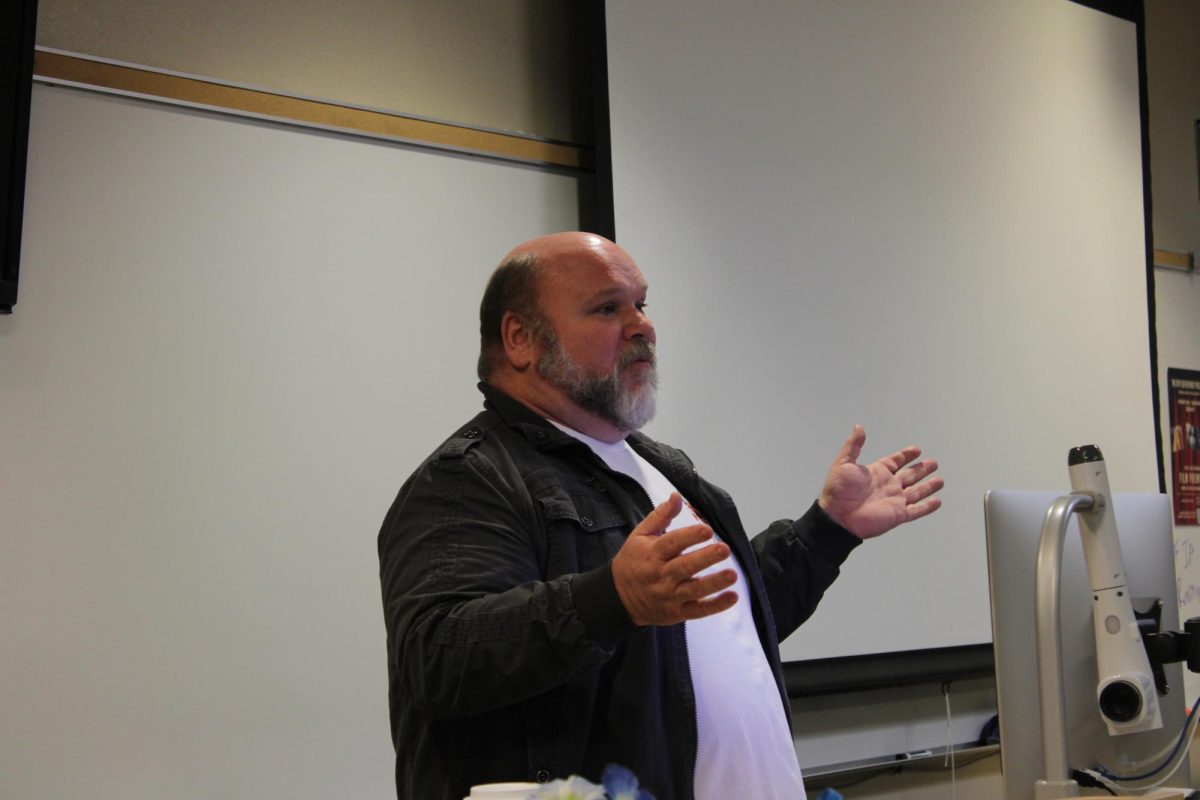
New radio, television and film professor, Justin Rettke, knew he wanted to teach at some point but didn’t know he would be teaching this early in his career.
Rettke’s education started in Redwood City, attending Cañada College for two years and Las Positas College for a year, before transferring into the University of Southern California School of Cinematic Arts, formerly known as Cinema-Television, earning a Bachelor of Arts in Critical Studies and later a Master of Fine Arts in the film production program.
Rettke said that before graduating from USC, he was already working small jobs in the film industry “bouncing back and forth” between lighting and cinematography gigs.
He said he had done many freelance jobs and side gigs, including gaffing and working as a director of photography, before he “got bored” with it in 2012. That same year, he said he got an interview at CBS Television through a fellow USC alum.
Rettke said he started working as an assistant writer on the TV show “Hawaii Five-0” in its third season.
“I got bumped up to the assistant to the executive producers, and then I got bumped up to script coordinator,” Rettke said. “I did seasons five and six as script coordinator.”
During his second year working on “Hawaii Five-0,” Rettke said that he had a shoulder injury that directly affected his job. He was told that it would take six months to recover, so he said he chose not to get the surgery and “lived with absolute agonizing pain” for three years.
Rettke said his relationship with the “Hawaii Five-0” showrunner had gone south over time, and he knew his time with CBS would be up soon, so he asked to finish up the sixth season.
“I asked to just finish the season, hand everything over to whoever he decided to replace me, so that it was the smoothest transition possible,” Rettke said.
After being out of work from surgery recovery for six months, Rettke got a call from a former boss from USC, asking if he knew anybody willing to work for the stage services department.
After coming back to USC, Rettke said his job initially was to fix the five stages in the Robert Zemeckis Center for Digital Arts and make them safe for students.
During his eight years at USC, Rettke was able to fix and convert each stage in the Zemeckis Center.
“I converted three whole stages to LED lighting from old school lighting. I designed a custom lighting control hack that utilized computers that they were retiring from the VFX lab,” he said.
While working at USC, Rettke was offered a position to teach an online film class at American River College.
After teaching online at ARC, Rettke was offered a two-year position in the RTVF department to fill in for Lauren Wagner, who is serving as Academic Senate president.
“It’s a short-term thing, which is scary-looking down the line, but at the same time it’s such a huge opportunity to teach here,” Rettke said. “It’s such a huge opportunity to be a full-time instructor and to actually commit myself completely to teaching.”
Rettke said that his experience in the industry has greatly helped his teaching style.
“It definitely impacts my prioritization when I’m looking at lesson plans,” Rettke said. “I’m preparing to talk about something where I’m just like, ‘Look, I know academically the book says this. It says that. It’s fine.’ The book is written by somebody and it was probably true at the time it was written, but things change too fast for books.”
Like Rettke, Wagner is also a USC alum, but they specialized in different areas in the film department during graduate school. Wagner said Rettke was more “nuts-and-bolts,” while she was more focused on the functionality of film student work spaces.
“We have similar stories from different stuff we did after graduation,” Wagner said. “But he can bring a perspective that we just don’t have in the department right now.”
Eleni Goetze, a 20-year-old film and media studies major, said that Rettke has a very “go-get-em attitude,” but knows how to set realistic expectations with his students.
“I think he does a very good job at supporting the vision I had for my film, but also making sure I was plausibly able to do it,” Goetze said.
Courtney Ramirez, an instructional assistant for the RTVF department, said that Rettke adds a lot of knowledge to the department from cinematography and lighting techniques to how to safely handle heavy-duty gear on set.
“Not a lot of students, since I’ve been here, have actually used the C-stands, and now since he’s been here for 350, the intermediate film class, they are now actively using C-stands, learning how to do three-point lighting more and we got flag equipment,” Ramirez said.
Though a course load of five classes can be a lot when you first start out teaching, Rettke said this is something he had to do.
“It was one of those things where I just, I looked at it, I’m like ‘I cannot not do this’,” he said.